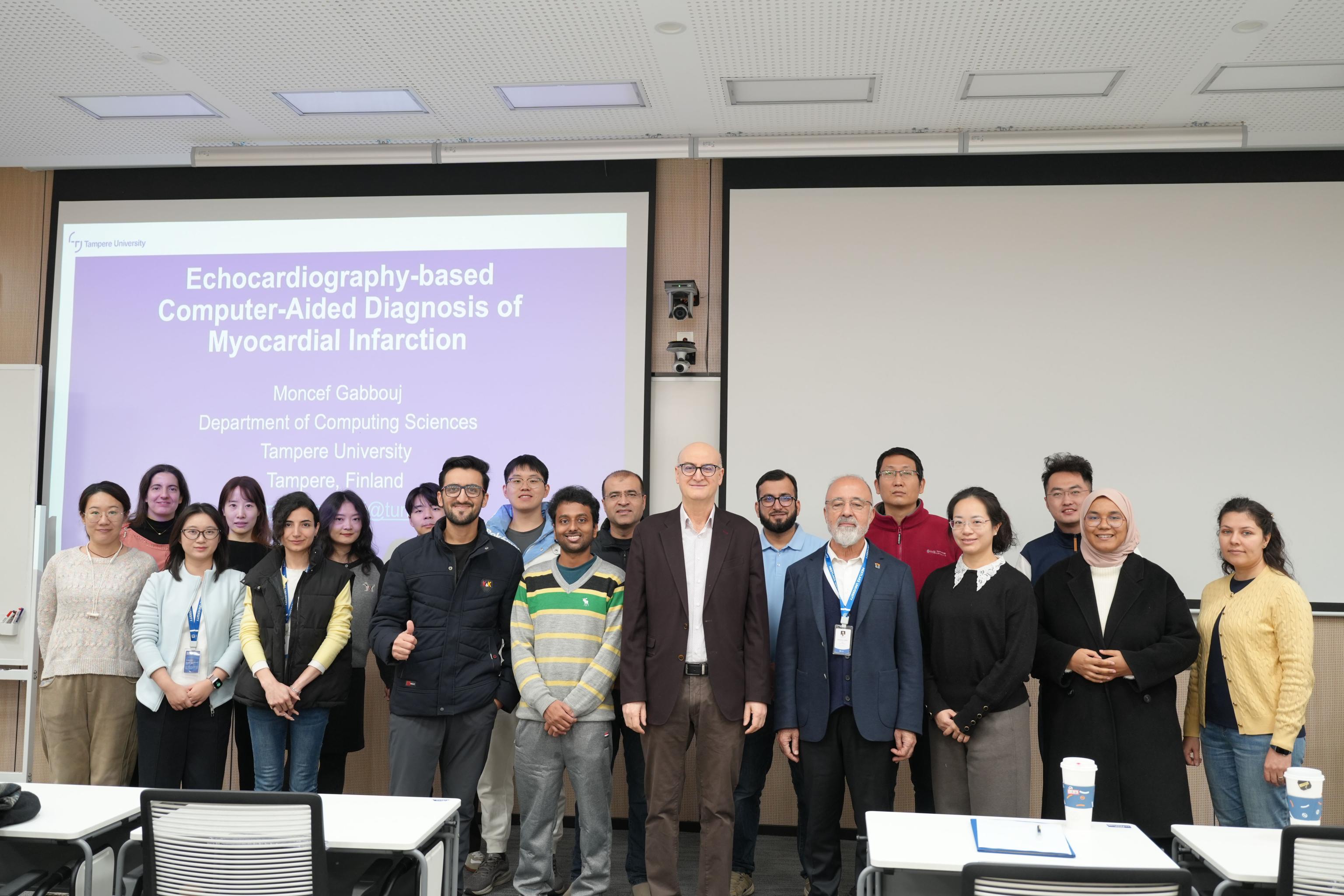
On December 24th, Professor Moncef Gabbouj from Tampere University, Finland visited Westlake University upon the invitation of Professor Mohamad Sawan, Chair Professor of the School of Engineering and Founding Director of the CenBRAIN Neurotech Center for Excellence at Westlake University. At our academic lecture event (CELLS), he delivered lecture titled "Echocardiography-based Computer-Aided Diagnosis of Myocardial Infarction".
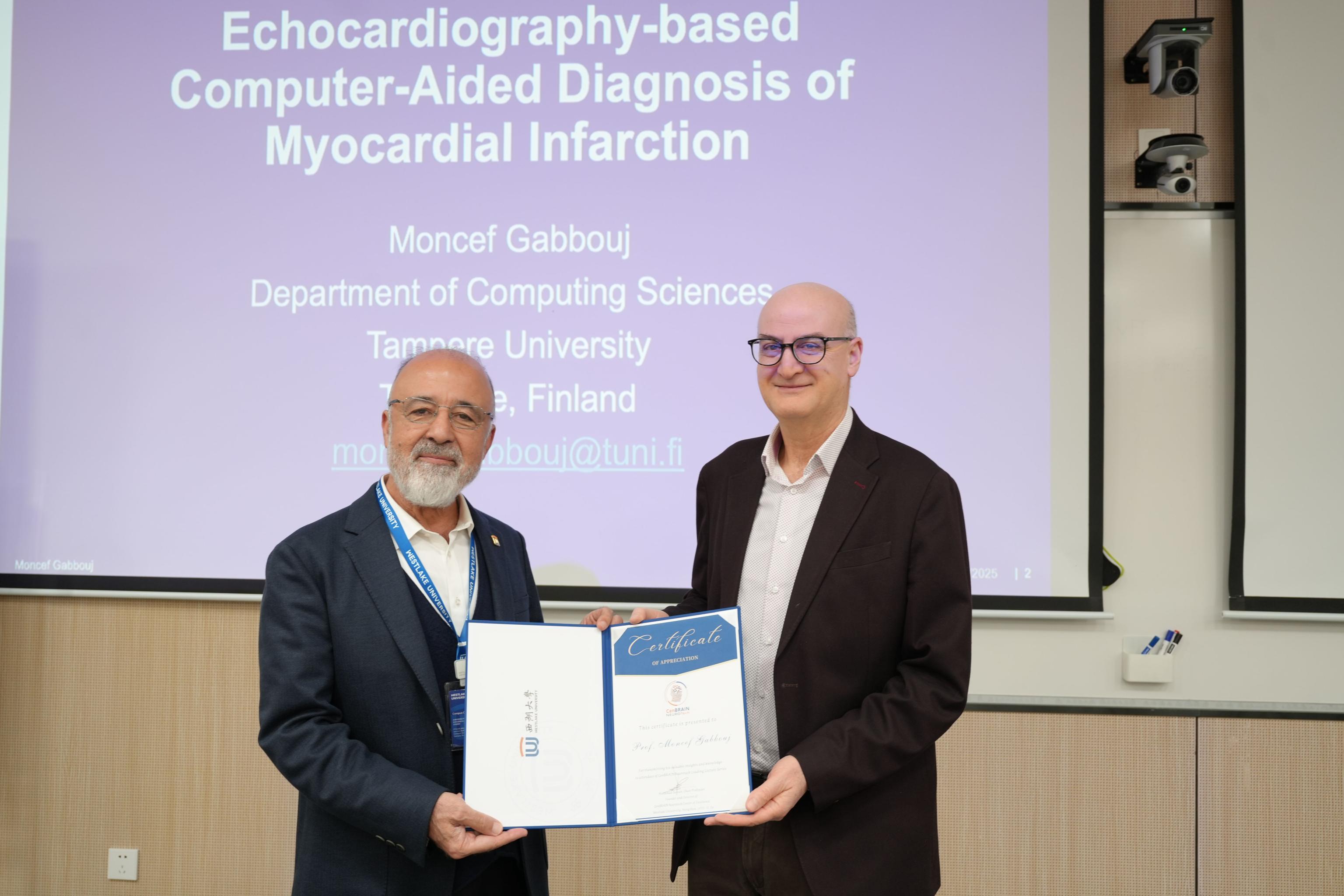
As an "long-time friend" of our research center, Professor Gabbouj had previously delivered a keynote speech at The 2023 IEEE International Conference on Artificial Intelligence Circuits and Systems (AICAS), which was chaired by Professor Sawan. Also, he gave a talk at the 3rd Westlake International Symposium in Engineering (WISE) organized by the School of Engineering of Westlake University. This time, he shared the latest advances from his team, presenting fresh insights to familiar faces and new connections alike in the audience.
About the Speaker
Professor Moncef Gabbouj is an internationally renowned expert in the fields of signal processing, artificial intelligence, and multimedia computing. He currently serves as a Professor of Information Technology at the Department of Computing Sciences, Tampere University, Tampere, Finland. In recognition of his outstanding contributions to nonlinear signal processing and video communication, he was elected as an IEEE Fellow in 2011, and subsequently as a member of the Academia Europaea and the Finnish Academy of Science and Letters in 2014.
Professor Gabbouj has authored or co-authored over 800 high-level academic papers and published three monographs. His research has been cited more than 38,800 times, and he boasts an h-index of 83, fully demonstrating his profound academic achievements and wide-ranging influence.
Abstract
In his presentation, Professor Gabbouj pointed out that computer-aided diagnosis (CAD) algorithms for disease detection and differential diagnosis are experiencing rapid development thanks to the swift advancement of machine learning technologies. These technologies provide crucial decision support for clinicians by performing pattern recognition and revealing anomalies in medical data. However, medical data faces numerous challenges in terms of scale, quality, and availability, necessitating the development of accurate, reliable, and robust CAD algorithms.
The lecture focused on the latest machine learning algorithms developed by his team for the detection and assessment of myocardial infarction (MI) using apical 4-chamber (A4C) and apical 2-chamber (A2C) view 2D echocardiography recordings. Myocardial infarction, the most severe manifestation of coronary artery disease, can lead to irreversible myocardial necrosis and even death. Its detection crucially relies on the assessment of regional wall motion abnormalities of the left ventricle (LV), for which 2D echocardiography serves as a primary tool.
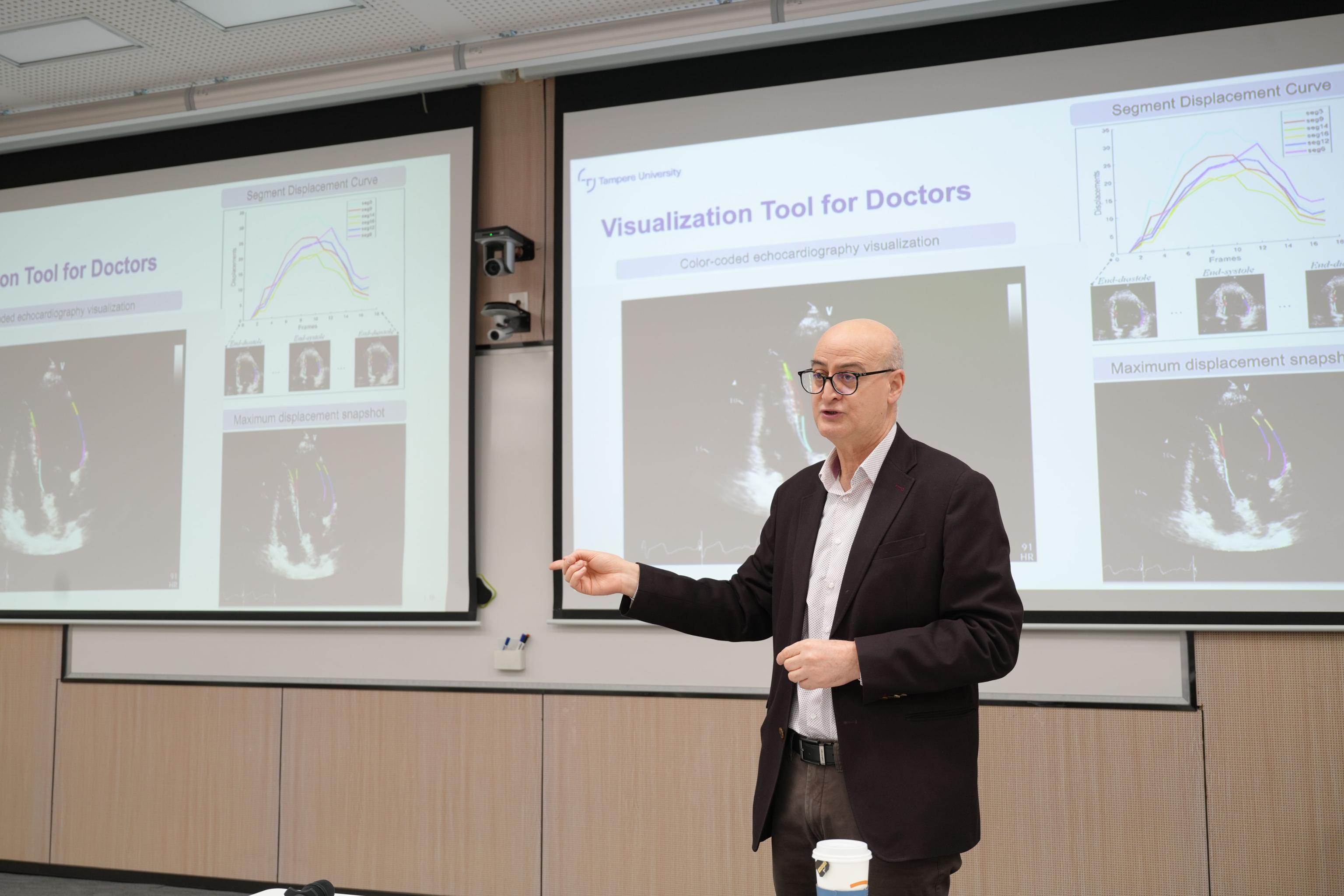
Professor Gabbouj presented his team's key advancements during the talk, including:
Development of single-view and multi-view echocardiography datasets for MI detection:
Providing cardiologists with intuitive, visually enhanced information through color-coding of LV boundaries in echocardiography recordings, displaying myocardial segment displacement curves, and integrating machine learning detection results.
Proposal of a generic human-machine collaborative annotation method:
This method accelerates and improves the quality of pixel-level manual annotations, effectively alleviating the heavy burden on physicians performing such detailed labeling.
Q&A Session
During the Q&A session, a lively discussion ensued between the attending faculty, students, and Professor Gabbouj.
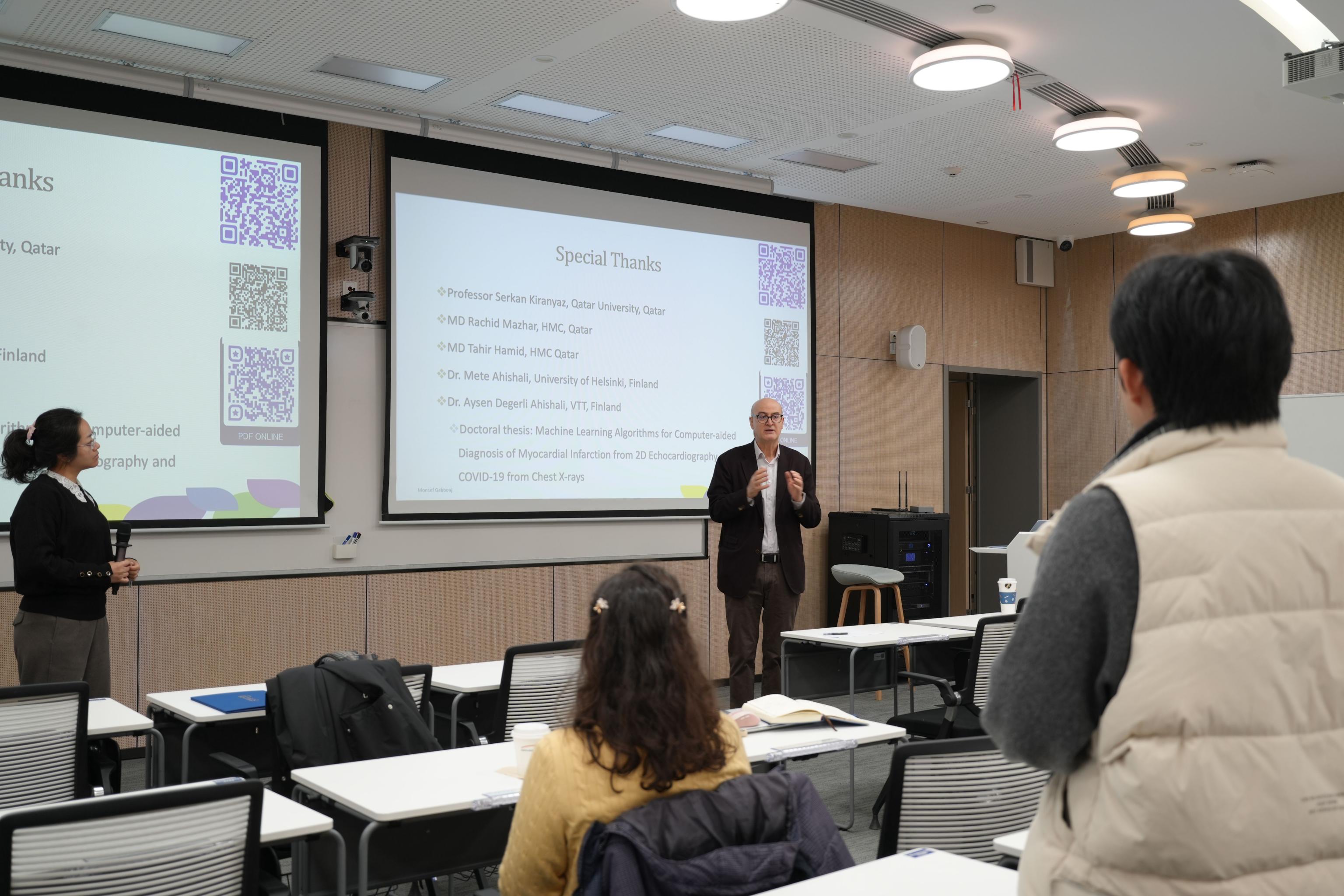
Addressing the question about "the gold standard for this work and the compatibility of simultaneous ultrasound and MRI measurements," Professor Gabbouj responded that cardiac magnetic resonance imaging (MRI) is currently considered the gold standard. He noted that achieving simultaneous measurement using an ultrasound transducer and MRI equipment, while technically challenging, is feasible. He mentioned that his team is currently attempting to advance a related project on ultrasound-MRI fusion.
When asked "how to ensure that the active polynomial features are robust to unseen scenarios and data,"Professor Gabbouj stated that the team has collaborated with clinicians to include as many diverse cases as possible to enhance system robustness. He also indicated that employing more advanced generalization techniques and collecting more diverse data in the future would further strengthen the system's performance in unseen scenarios.