Recently, the article “A wearable electrochemical aptasensor based MOF on MOF heterostructure for multi-neurotransmitters monitoring” from the CenBRAIN Neurotech Center of Excellence has been selected as the Outstanding Paper Award 2025 of Microchimica Acta Journal!
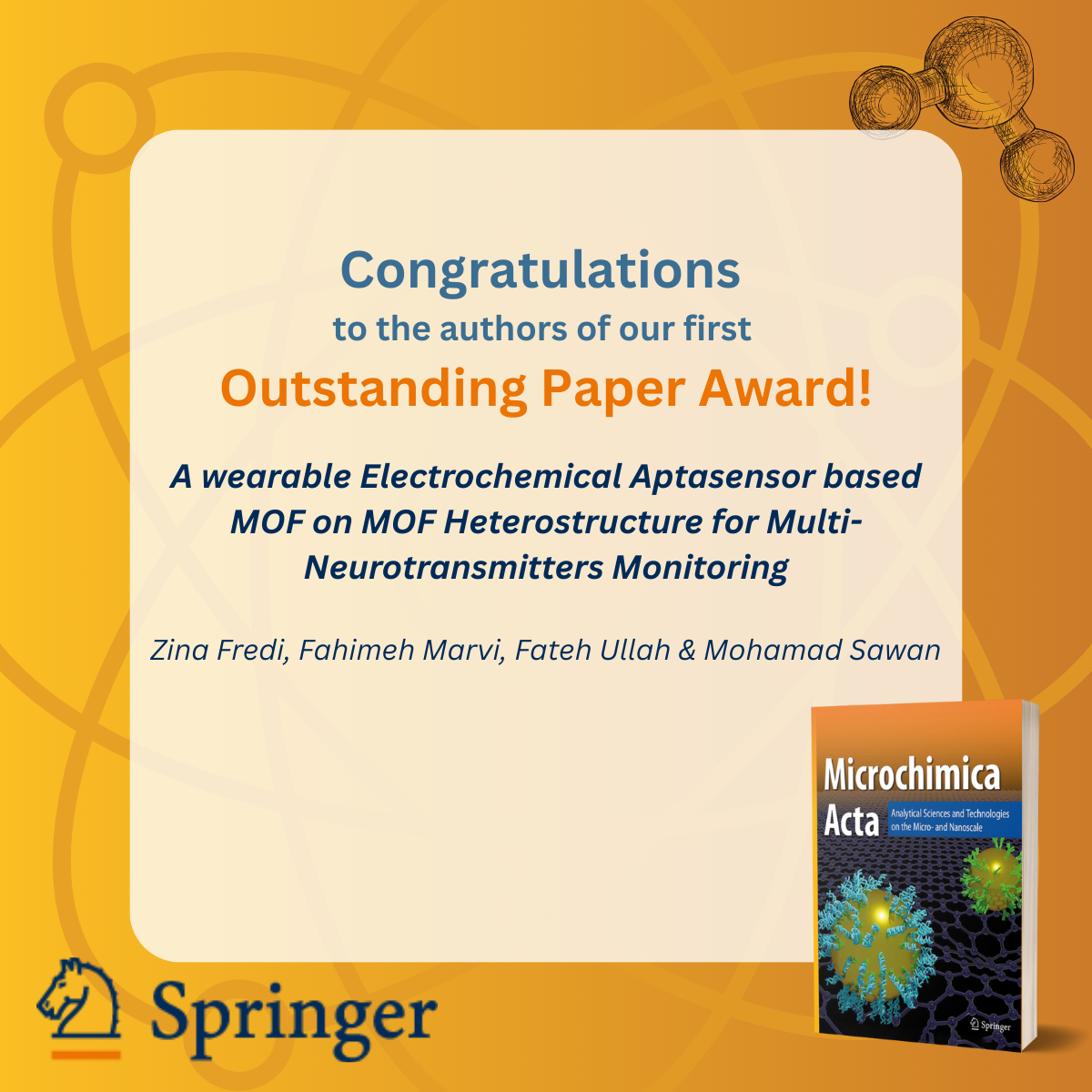
This award is presented annually to a single paper, selected through a vote by the Editorial Board of the Microchimica Acta journal. Dr. Zina Fredj, former Research Assistant Professor of CenBRAIN Neurotech is the first author of the paper. Research Assistant Professors from our Center, Dr. Fahimeh Marvi and Dr. Fateh Ullah, are co-authors. Chair Professor Mohamad Sawan is the corresponding author. The authors gratefully acknowledge the support from Westlake University, Leading Innovative and Entrepreneur Team Introduction Program of Zhejiang and the National Natural Science Foundation of China.
Reference
Fredj, Z., Marvi, F., Ullah, F., and Sawan M., A wearable electrochemical aptasensor based MOF on MOF heterostructure for multi-neurotransmitters monitoring. Microchimica Acta Journal, 192, 384 (2025).
More information can be found at the following link:
https://link.springer.com/article/10.1007/s00604-025-07219-5
Abstract
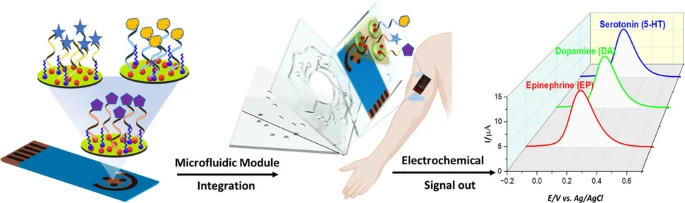
Fig.1. Graphical Abstract.
A wearable electrochemical biosensor for real-time monitoring of neurotransmitters in sweat during physical exercise is presented. The biosensor utilizes a CuMOF@InMOF architecture, enhanced with gold nanoparticles (AuNPs), to improve electron transfer, surface area, and overall stability. Thiolate nucleic acid aptamers, highly specific to dopamine, serotonin, and epinephrine, are immobilized on the biosensor surface, enabling precise and simultaneous detection of these key neurotransmitters.
The flexible, multi-electrode platform is integrated into a microfluidic patch that adheres to the skin, facilitating seamless sweat collection and continuous neurochemical analysis. Structural validation confirmed the successful synthesis of the CuMOF@InMOF architecture with enhanced surface area, stability, and electron transfer properties, contributing to the biosensor's high sensitivity and selectivity. Impressively, the biosensor achieved detection limits of 0.18 nM for dopamine, 0.33 nM for serotonin, and 0.27 nM for epinephrine, with a broad dynamic range from 1 nM to 10 µM. Performance was validated through square wave voltammetry and amperometry, demonstrating exceptional sensitivity, selectivity, and stability. This innovative biosensor offers a powerful tool for non-invasive, real-time neurochemical monitoring, with significant potential in personalized healthcare.
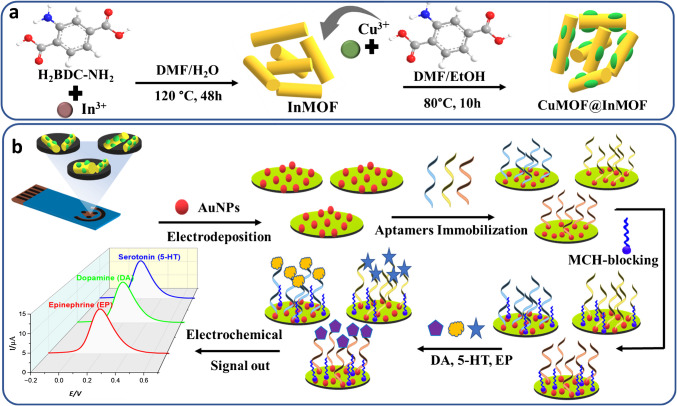
Fig. 2. Biosensor Preparation: a) CuMOF@InMOF chemical components and synthesis steps, b) Schematic diagram of the multi-neurotransmitters’ biosensor based on Aptamers-Coupled AuNPs@CuMOF@InMOF from surface functionalization to signal deliverance.
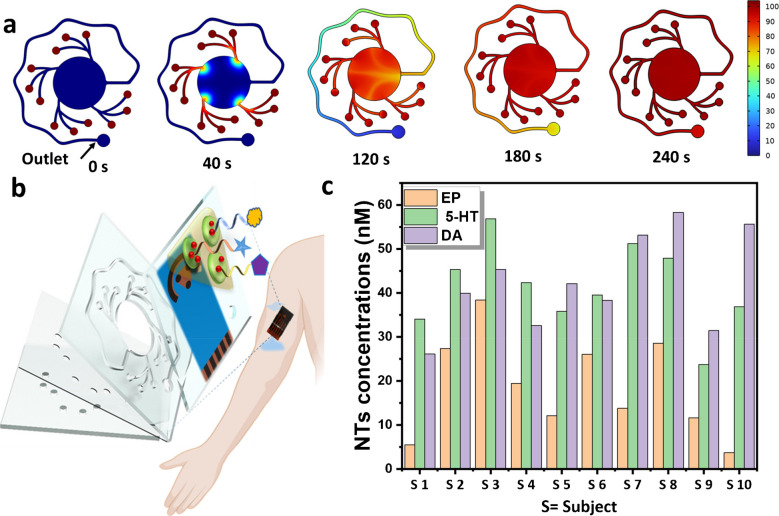
Fig. 3. On body monitoring: a) Simulations of solute concentration distributions on the bottom surface of the microfluidic chamber over time, illustrating the dynamic diffusion and interaction of analytes within the microfluidic environment. The progression is shown at distinct time intervals, with the color scale representing concentration levels from low (blue) to high (red), b) Schematic representation of the wearable biosensor system applied on the forearm for neurotransmitter monitoring. The system integrates a microfluidic channel with a flexible electrode platform for real-time sweat collection and analysis, and c) NTs concentrations (EP, 5-HT, and DA) measured in sweat samples from 10 healthy volunteers aged 27–40 after exercise, based on calibration-derived values.