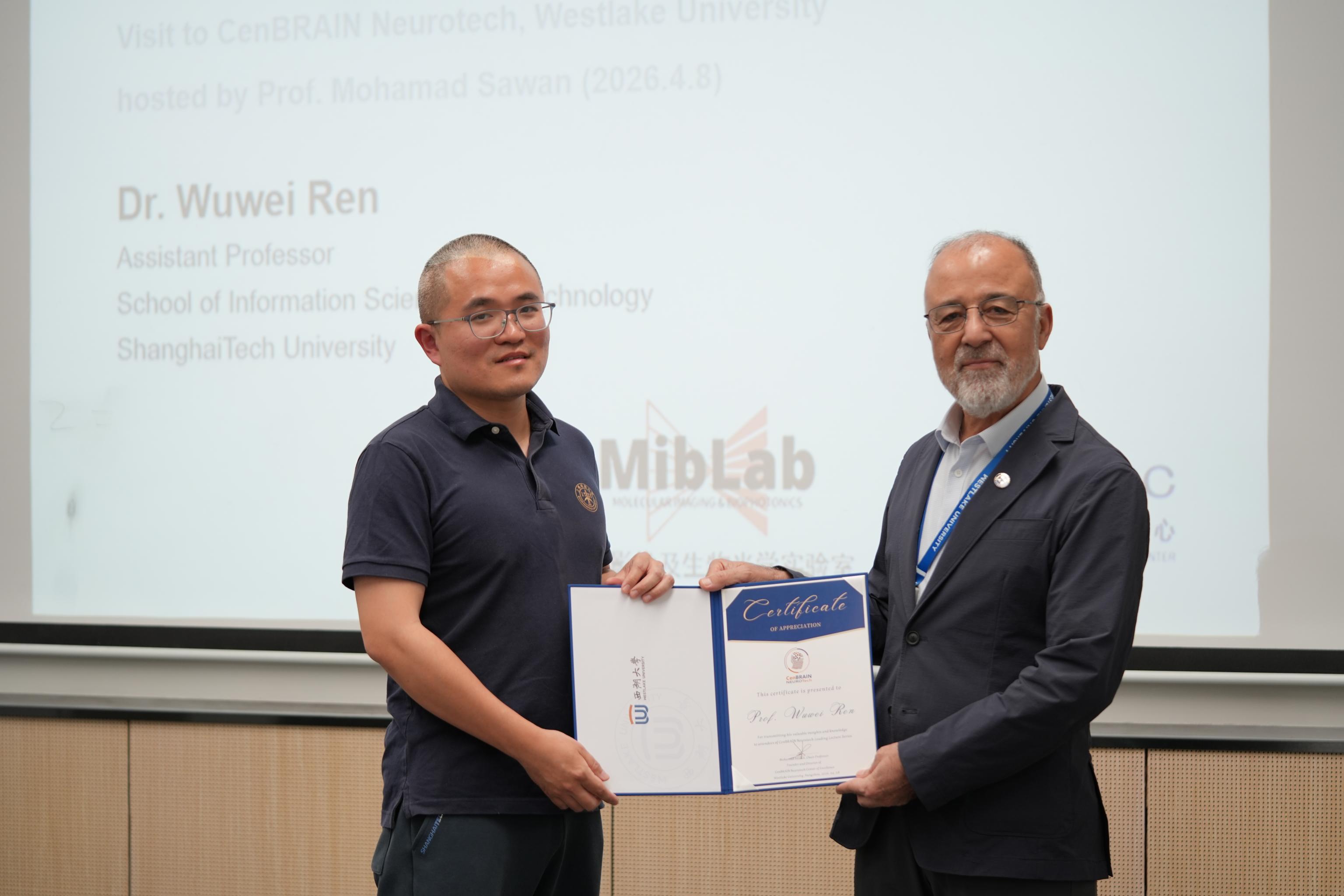
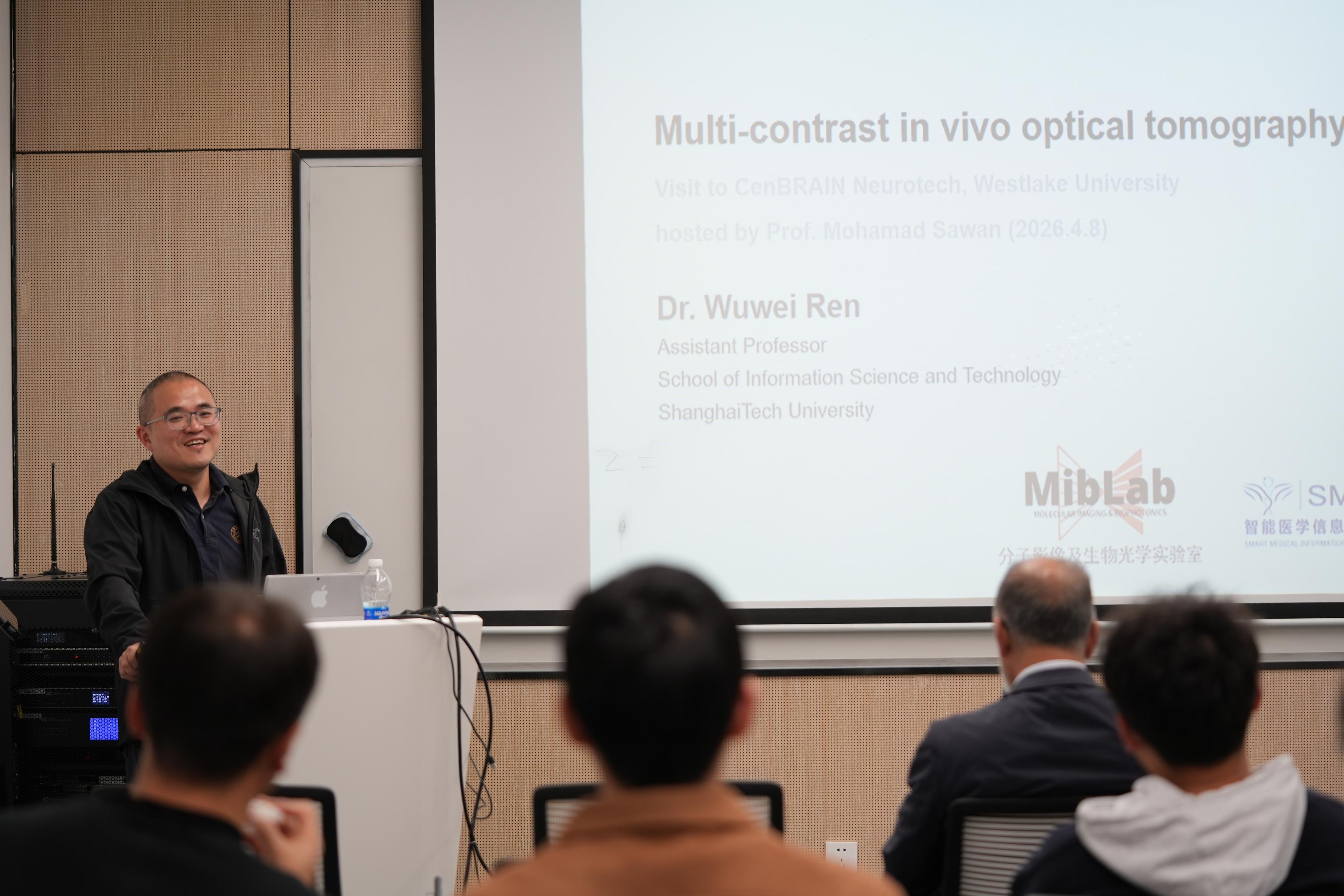
At the beginning of April, the 56th CenBRAIN Neurotech Leading Lecture Series (CELLS) event of the CenBRAIN Neurotech Center of Excellence, School of Engineering, Westlake University took place as scheduled. Invited by Chair Professor Mohamad Sawan, Professor Wuwei Ren from ShanghaiTech University visited the campus and delivered an insightful talk titled “Multi-contrast in vivo optical tomography.”
About the Speaker
Professor Wuwei Ren is currently an Assistant Professor at the School of Information Science and Technology, ShanghaiTech University. His research focuses on optical imaging, image reconstruction, and multi-modal image fusion, with applications in fluorescence-guided surgery and brain-computer interfaces. He received his bachelor’s degree from Zhejiang University, master’s from KTH Royal Institute of Technology (Sweden), and Ph.D. from ETH Zurich (Switzerland), all in Biomedical Engineering. He subsequently conducted postdoctoral research at the University of Zurich. Professor Ren has published in leading journals such as Nature Communications, Laser & Photonics Reviews, and IEEE TBME, and serves as an editorial board member for the journal Neuroelectronics.
About CELLS
The CenBRAIN Neurotech Leading Lecture Series (CELLS) is our center-level seminar series, established to create a platform for stimulating academic discussion. It invites leading experts to present their groundbreaking work in fields such as bioelectronics, integrated circuits, microchips, biosignal recording, and organ-on-chip technology. Since its launch in 2022, the series has successfully hosted 55 sessions, featuring renowned scholars from around the world who share their latest findings in brain-computer interfaces, organ-on-a-chip, closed-loop neuromodulation, neuroimaging, and related fields. The series provides a stable and valuable platform for academic exchange among faculty and students.
In this talk, Professor Ren systematically introduced recent advances in multi-contrast in vivo optical tomography and its biomedical applications, offering new insights at the intersection of optical imaging and neural engineering.
Professor Ren began by explaining the concept of “multi-contrast” in medical imaging, using magnetic resonance imaging (MRI) as an example to illustrate the clinical value of integrating multi-sequence, multi-parametric information. He noted that in optical imaging, multi-contrast techniques not only enrich data dimensionality but also help address key challenges in quantitative imaging. For instance, deviations in optical absorption and scattering coefficients in fluorescence imaging can significantly affect 3D quantitative reconstruction of fluorescent probes. A multi-contrast strategy that simultaneously acquires optical properties and fluorescence distribution can effectively resolve this issue.
Professor Ren then highlighted the multi-contrast optical tomography system (SHMOT) developed by his laboratory. The system integrates structured light illumination, SPAD array detection, and pulsed laser modulation, enabling simultaneous high-precision reconstruction of tissue surfaces, 3D analysis of optical absorption and scattering coefficients, and visualization of quantitative distribution of exogenous fluorescent probes. After validation through digital simulations and phantom experiments, the system has been successfully applied to in vivo imaging of the tumor microenvironment and dynamic monitoring of temperature fields during thermal ablation in mice, demonstrating promising application prospects.
During the Q&A session, Professor Ren answered questions on improving image quality and reducing scattering and background noise, and also shared corresponding solutions in signal processing.
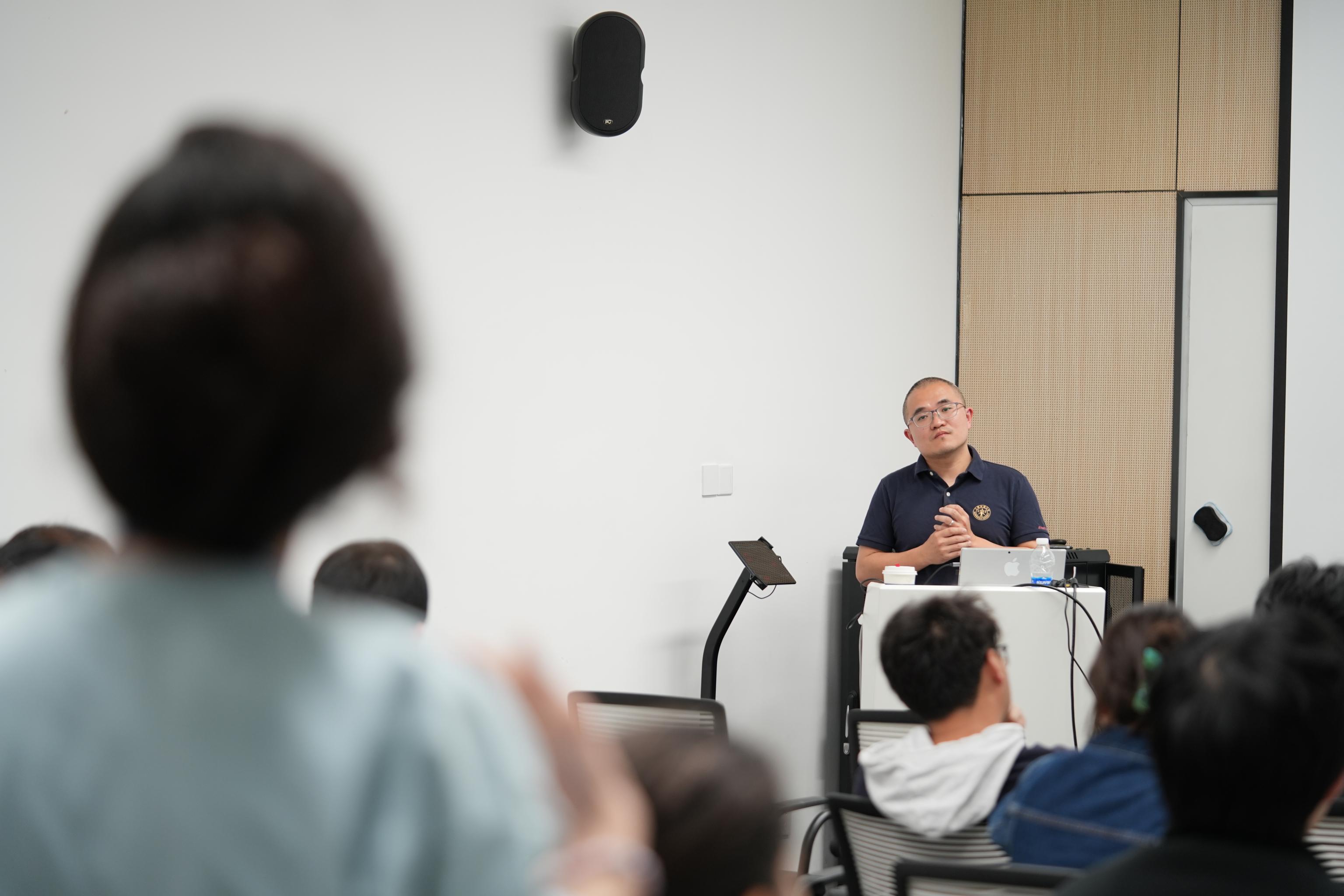
This lecture offered faculty and students an in-depth look at the latest advances in multi-contrast optical imaging, while inspiring center members working at the intersection of optical imaging, multi-modal fusion, and neural engineering. We thank Professor Ren for his excellent talk and all attendees for their engagement. Looking ahead, CELLS will continue to bring outstanding scholars to foster high-level exchange and support the integration of brain science, neural engineering, and biomedical engineering.