The coordinated communication between the brain and muscles is an essential prerequisite for every fluid movement of the human body.
Corticomuscular coherence (CMC) is a key neural metric that quantifies this brain-muscle dialogue. It reveals how the cerebral cortex controls muscle movement and assesses the strength of functional coupling between the motor cortex and relevant muscles.
However, in stroke patients, this pathway is often disrupted. The information transmission between the cortex and muscles becomes impaired, leading to motor dysfunction and a severely diminished quality of life.
Recently, a new review study has thoroughly examined the important role of corticomuscular coherence in post-stroke functional recovery. The study systematically outlines the physiological origins of CMC in movement execution, analyzes how stroke disrupts these coherence patterns, and summarizes non-invasive neuromodulation therapeutic strategies based on these abnormal patterns. This work offers a new theoretical perspective for understanding the neurophysiological mechanisms of movement and for improving stroke rehabilitation.
This research contribution was published in March 2026 and featured in the journal Neuroimage Reports. Dr. Yuchen Xu, a former postdoctoral fellow at the CenBRAIN Neurotech Center of Excellence, is the first author, with Chair Professor Dr. Mohamad Sawan serving as the corresponding author. This work holds promise for bringing more precise intervention strategies to stroke rehabilitation.
Abstract
Neural activities are widely observed in the central nervous system and are essential for movement execution. Corticomuscular coherence (CMC) represents the coherence of oscillatory communication between motor cortex and peripheral muscles. Motor function impairments caused by stroke often involve abnormal CMC patterns.
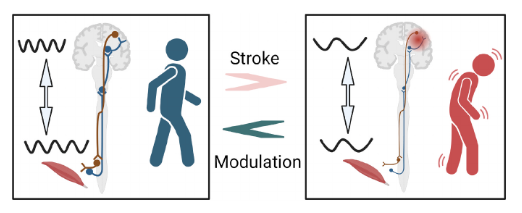
Fig. 1. CMC enables people to perform voluntary movement, while stroke disrupts the CMC patterns and leads to motor impairments. Modulation strategies provide potential solution for movement disorder recovery.
This review aimed to investigate CMC and how to modulate them for post-stroke functional recovery. We first introduced the origins of CMC in movement execution. We then explored how stroke affects CMC. Based on these abnormal CMC patterns, we summarized potential non-invasive neuromodulation strategies. A deeper understanding of CMC in beta band (∼15-30 Hz) could clarify the physiological mechanisms underlying movement and aid in improving stroke rehabilitation.
Reference
Xu Y, Zhang S, Wang M, Sawan M. Corticomuscular coherence and its non-invasive modulation in stroke applications: a narrative review. Neuroimage Rep. 2026;6(1):100329.
More information can be found at the following link:
https://www.researchgate.net/figure/Oscillation-modulated-by-tDCS_tbl2_401409381