Neural cell culture and neural network construction are fundamental to neuroscience research, disease model establishment, and drug screening.
Traditional neural cell culture methods mostly rely on natural substrate materials such as poly-L-lysine or laminin.
However, these materials have limitations including complex composition, poor controllability, and significant batch-to-batch variability. Furthermore, existing technologies struggle to achieve precise regulation of both two-dimensional neural network structures and three-dimensional models on a single platform.
With the advancement of neural engineering and organoid technologies, researchers urgently need an interface material that is programmable, controllable, and highly stable to precisely regulate neural cell adhesion, growth, and spatial organization. Therefore, developing an artificial interface material based on molecular design that enables controlled cell adhesion and spatial organization is of great significance for constructing highly controllable neural culture platforms.
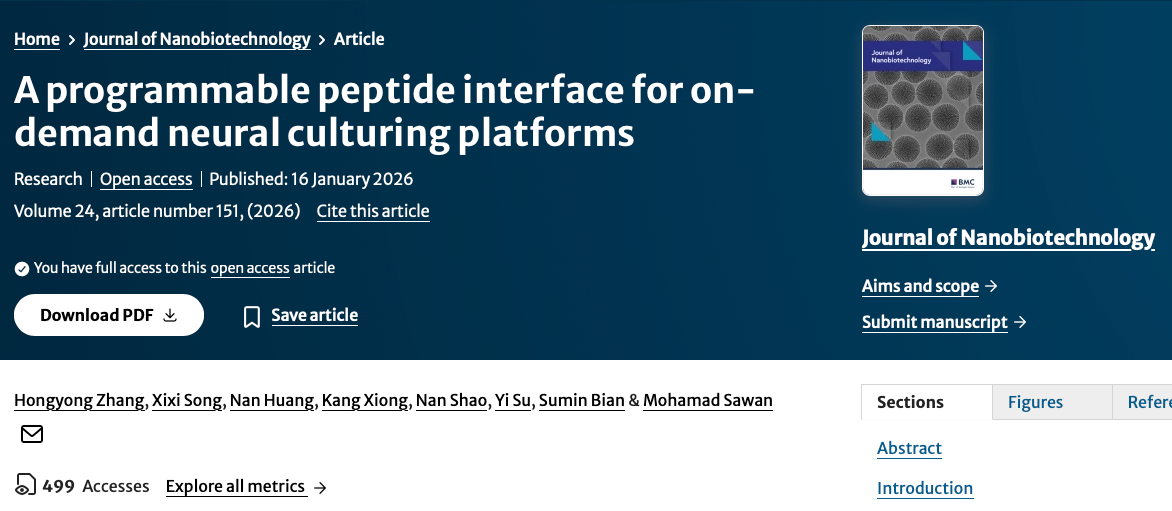
Recently, a research contribution from Professor Mohamad Sawan's group was published in the Journal of Nanobiotechnology. Our Postdoctoral fellow Hongyong Zhang and research assistant Xixi Song are co-first authors, Chair Professor Mohamad Sawan is the corresponding author.
Research Highlights
(1) Construction of Programmable Peptide Interface Material
The study proposes a novel PNA fusion protein that modularly integrates a silicon-binding peptide with a cell-adhesive RGD polypeptide, enabling precise design of the cell-material interface and thus achieving stable connections between neural cells and solid substrates.
(2) Precise Patterning of Two-Dimensional Neural Networks
By combining photolithography with the PNA interface, neural cell adhesion regions can be controlled on a micrometer scale, allowing neurons to grow along predefined patterns and form complex neural network structures.
(3) Controllable Formation of Three-Dimensional Neural Spheroids
By modifying the RGD structure and the rigidity of the linker peptide, neural cells can self-assemble into uniformly sized 3D neural spheroids, providing a new strategy for high-throughput neural spheroid culture.
(4) Compatibility with Neural Electrophysiological Recording Platforms
The cultured neural spheroids can record stable neural firing signals on multi-electrode arrays (MEAs), demonstrating their mature neural functionality and providing a reliable platform for neural disease modeling and drug screening.
Abstract
This study designed and constructed a programmable neural anchor (PNA) protein, which fuses a silicon-binding tag (Si-tag) with a cell-adhesive RGD polypeptide domain to form a bifunctional molecular interface, thereby enabling stable immobilization and controlled growth of neural cells on glass or silicon substrates.
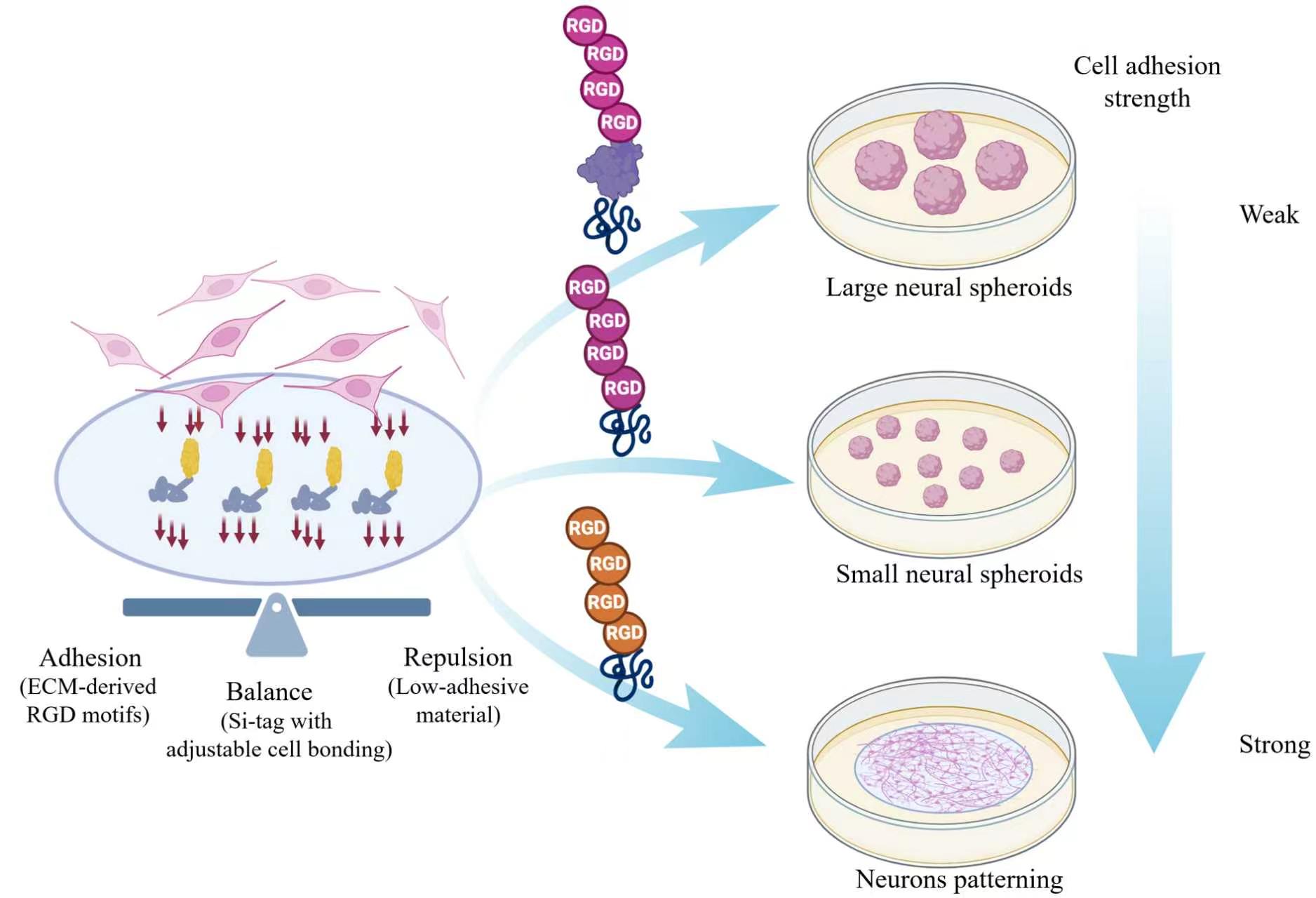
Fig.1. Schematic diagram of programmable dual-function peptide interfaces inducing the assembly of2D neuronal networks and 3D neural spheroids.
The researchers employed photolithography to create micropatterns on glass substrates, utilizing PNA to achieve selective adhesion and network formation of neural cells in specific regions. Additionally, by adjusting the RGD sequence and linker structure, the platform enables neural cells to self-assemble into uniformly sized three-dimensional neural spheroids. Experimental results show that this system not only supports neural cell survival and maturation but also allows stable recording of neural electrical activity on multi-electrode arrays (MEAs), demonstrating its capability to construct functional neural network models. This study provides a highly controllable neural culture platform for neural engineering, disease model construction, and drug screening.
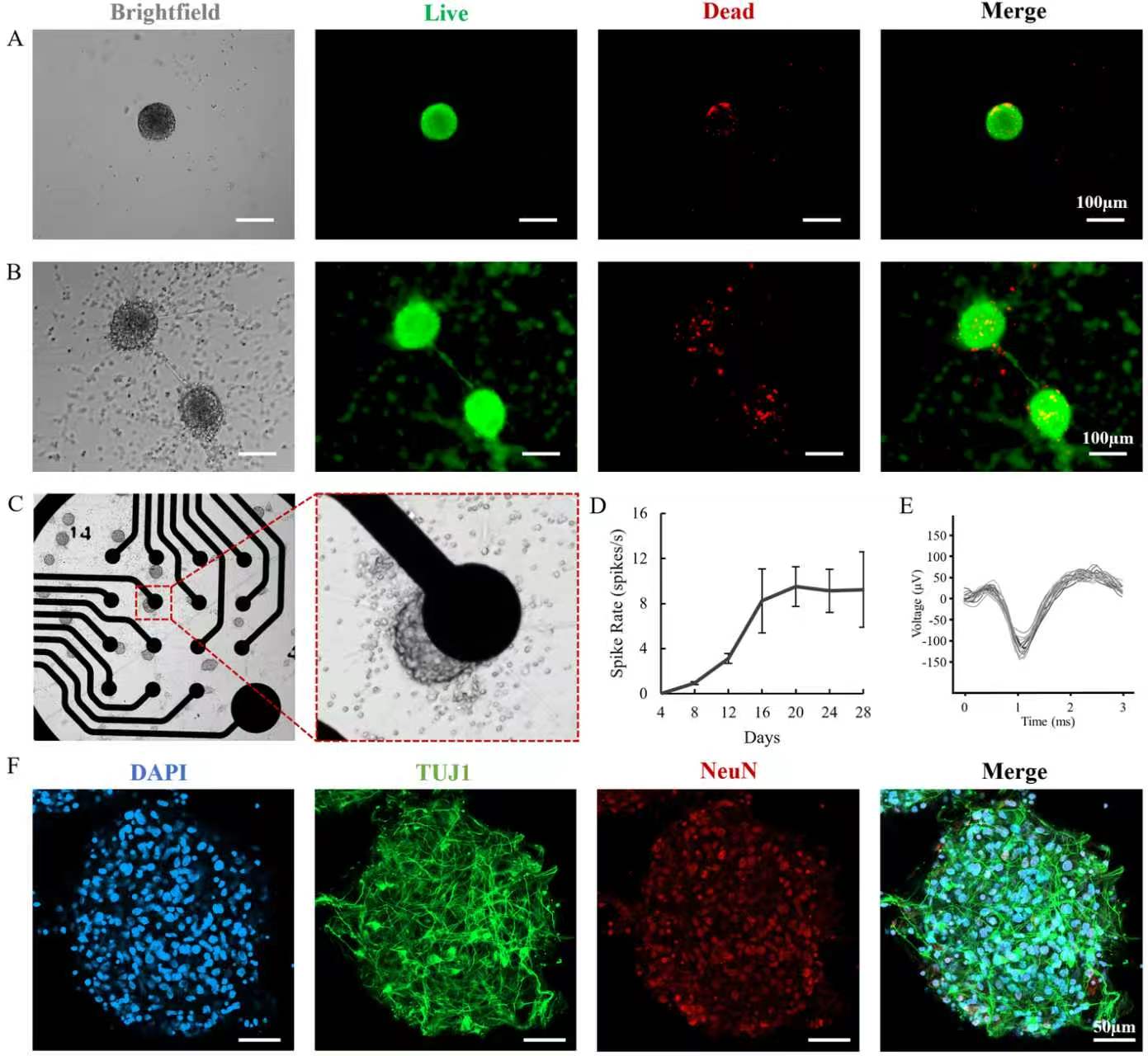
Fig.2. Characterization of neural spheroids cultured with programmable peptide coatings and evaluation of their electrophysiological activity.
Reference
Zhang, H.*, Song, X.*, Huang, N., Xiong, K., Shao, N., Su, Y., Bian, S and Sawan, M. A programmable peptide interface for on-demand neural culturing platforms. J Nanobiotechnol 24, 151 (2026). https://doi.org/10.1186/s12951-026-04032-x