From blinding sunlight to near darkness, the human eye adapts in an instant — no manual tuning, no gain adjustment. This remarkable versatility stems from the retina’s inherent nonlinear encoding of light intensity.
For machines, however, scenes where bright and dim light coexist — such as tunnel entrances or the endless twilight of polar regions — remain a persistent challenge. Conventional sensors either saturate under strong illumination or lose critical details in the shadows.
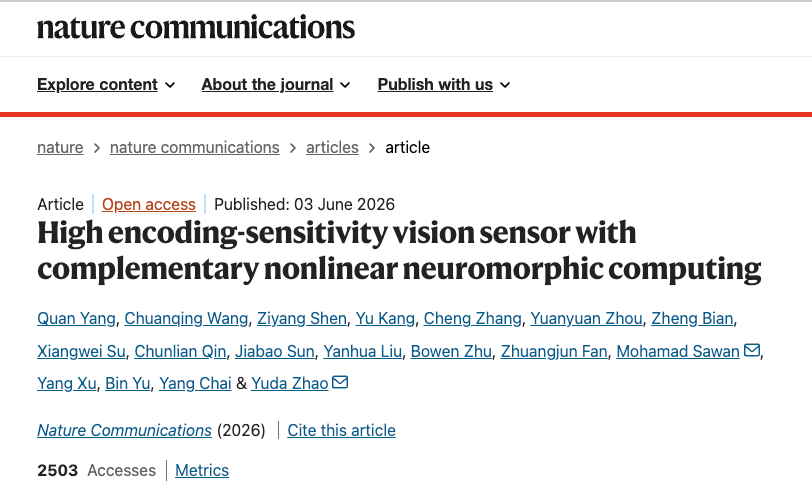
Now, a joint effort between Westlake University's CenBRAIN Neurotech Center of Excellence and Zhejiang University's School of Integrated Circuits has produced a neuromorphic vision sensor capable of sustaining high encoding sensitivity across an exceptionally broad intensity range. Published in Nature Communications under the title "High encoding‑sensitivity vision sensor with complementary nonlinear neuromorphic computing" this work provides a hardware pathway toward reliable machine vision under extreme lighting conditions.
Dr. Quan Yang from the School of Integrated Circuits at Zhejiang University, and Dr. Chuanqing Wang, a 2024 graduate of the CenBRAIN Neurotech Center of Excellence at Westlake University are co‑first authors of this work.
Dr. Mohamad Sawan, Chair Professor at Westlake University, and Dr. Yuda Zhao from the School of Integrated Circuits at Zhejiang University, sever as co‑corresponding authors.
The collaborating institutions include the Micro‑Nano Fabrication Center of Zhejiang University, the Key Laboratory of 3D Micro/Nano Fabrication and Characterization of Zhejiang Province at Westlake University, and the Department of Applied Physics at the Hong Kong Polytechnic University. This research was supported by the National Natural Science Foundation of China, the National Key Research and Development Program of China, the Natural Science Foundation of Zhejiang Province, the China Postdoctoral Science Foundation, the Research Grants Council of Hong Kong, and the Zhejiang Province Kunpeng Action Program.
Why Complementary Nonlinearity Matters
Neuromorphic vision sensors emulate the retina by converting light directly into sparse spike trains — the native format of spiking neural networks (SNNs), which process visual information with remarkable energy efficiency. To cope with real‑world illumination, such sensors require a nonlinear input‑output relationship: superlinear behavior suppresses noise in low light and boosts contrast under bright conditions, while sublinear behavior preserves fine details in dim scenes. The challenge, however, is that most existing devices offer only one of these responses, which restricts their effective dynamic range. The key innovation of this study lies in combining both nonlinearities in a complementary manner, thereby achieving high sensitivity from darkness to broad daylight.
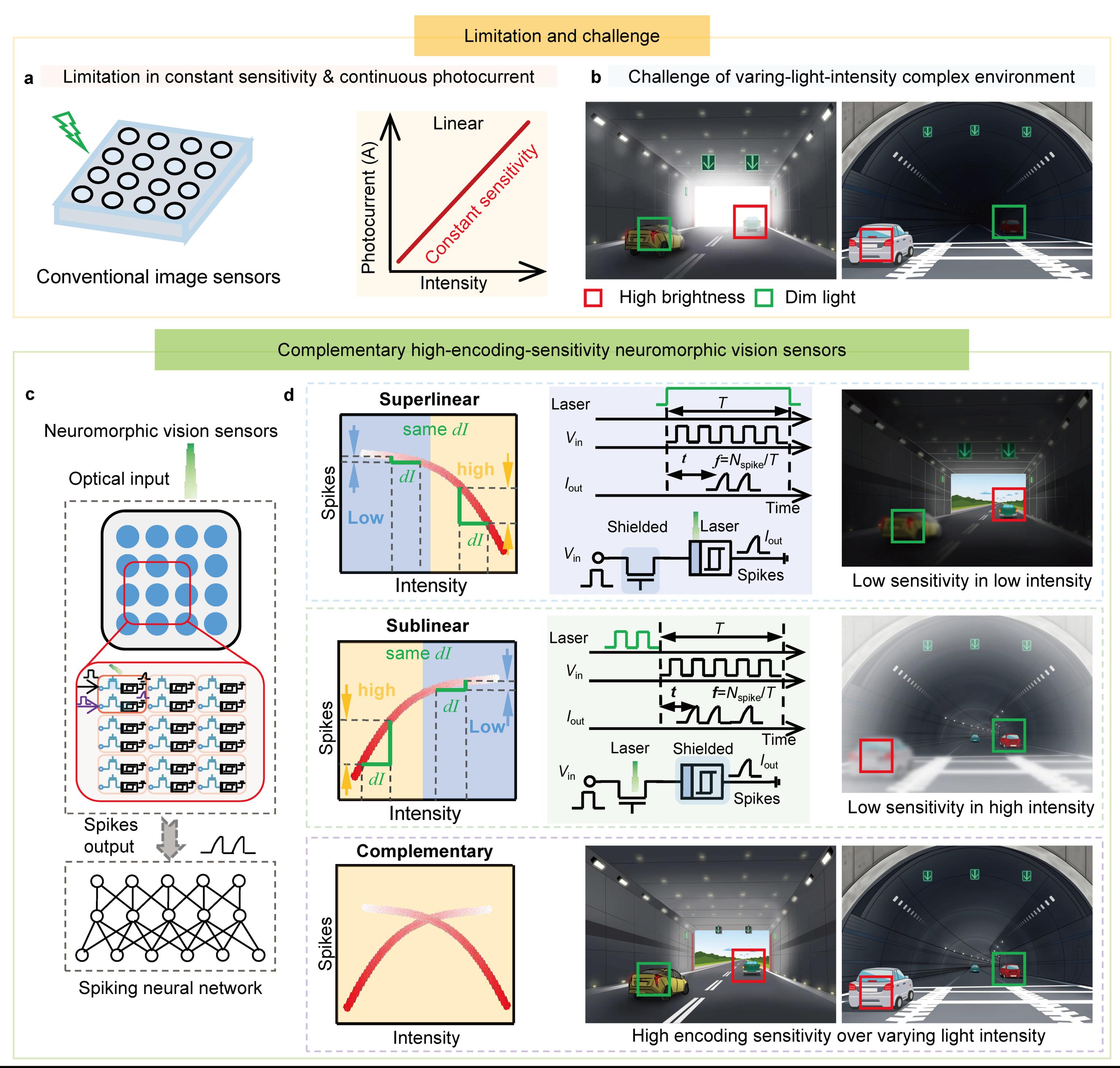
Fig. 1. Working principle of the complementary neuromorphic vision sensor
The 1T1R pixel unit operates in the superlinear mode under high brightness (the memristor senses light and fires spikes) and in the sublinear mode under dim light (the MoS₂ transistor senses light while the memristor acts as a spiking neuron). The two complementary nonlinear encoding modes extend the high encoding-sensitivity region to a dynamic range of 111 dB.
One Pixel, Two Modes
Our team built a 1T1R pixel — one transistor, one memristor — using a MoS₂ phototransistor paired with a plasmonic volatile Ag/hBN/Au memristor.
Superlinear mode (bright conditions): Light directly hits the memristor, triggering spike firing in a superlinear fashion via plasmonic effects. This mode achieves a time‑to‑first‑spike (TTFS) encoding sensitivity of about 0.1 ms·cm²·mW⁻¹.
Sublinear mode (dim conditions): The MoS₂ transistor acts as a synaptic photodetector, while the memristor serves as the spiking neuron. This configuration maintains a high encoding sensitivity of roughly 0.2 ms·cm²·mW⁻¹ under low light.
The two modes switch seamlessly within the same pixel, extending the effective dynamic range to approximately 111 dB — far beyond what a single‑nonlinearity design can achieve. And because the output is spike‑based rather than continuous analog current, power consumption remains low.
Put to the Test in the Polar Region
The sensor was evaluated in a polar remote‑sensing scenario, where extreme daylight and weak polar‑night illumination coexist in the same field of view — a worst‑case test for dynamic range. The superlinear and sublinear modes extracted features from bright and dark regions, respectively. After fusion processing through an SNN, the system delivered accurate sea‑ice/land segmentation and ice‑thickness classification, with results closely matching ground truth. Performance significantly outperformed either encoding mode used alone, demonstrating strong robustness under challenging lighting conditions.
By integrating perception, encoding, and nonlinear processing into a single pixel, this work provides a device‑level building block for energy‑efficient, wide‑dynamic‑range neuromorphic vision systems. Potential applications span polar exploration, autonomous driving, and surveillance — any scenario where machines must see reliably in unpredictable or extreme light.
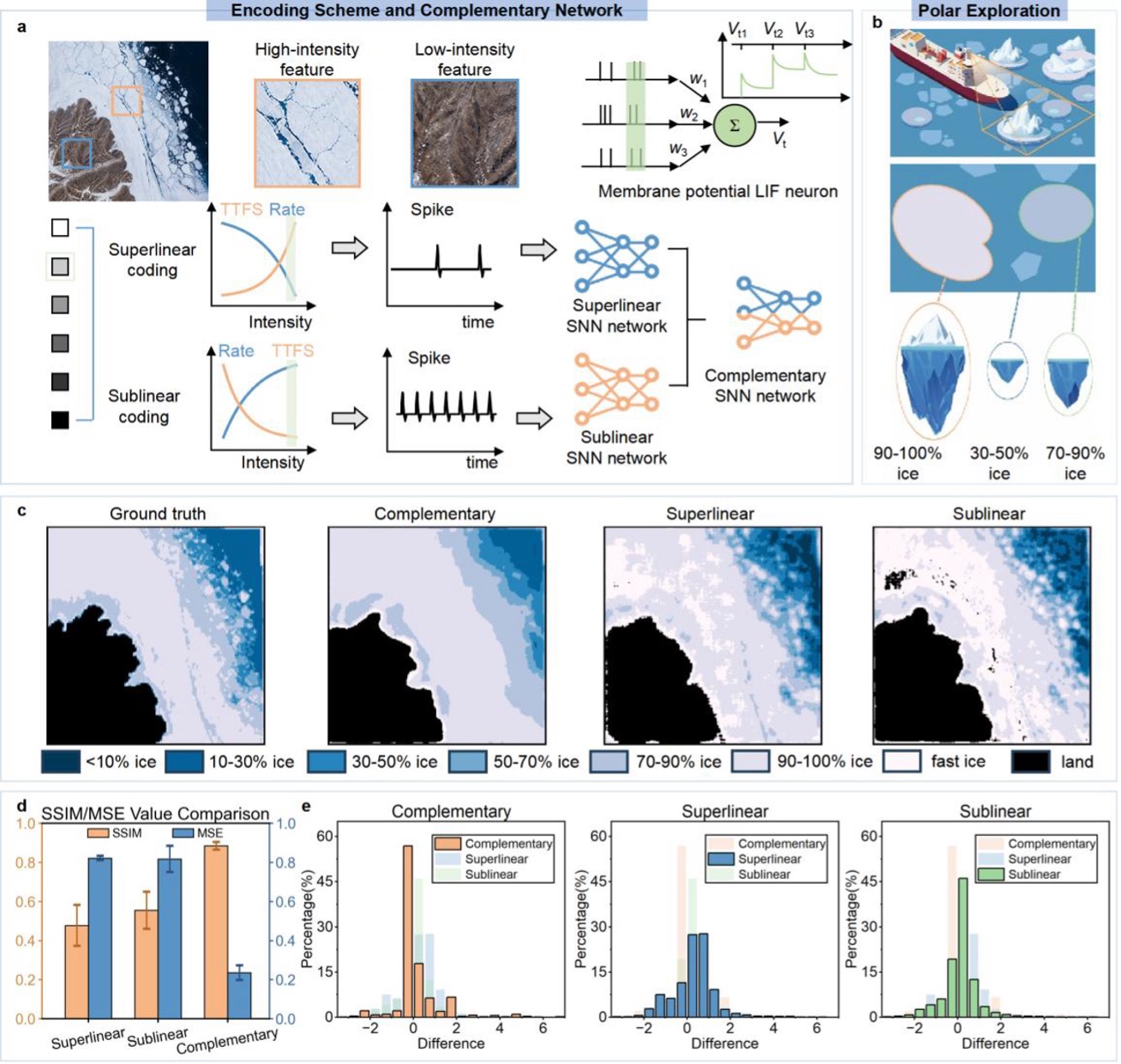
Fig. 2. Demonstration in polar exploration
Superlinear and sublinear encoding extract features from high-brightness and dim-light regions, respectively. After processing and fusion by spiking neural networks, the sensor achieves sea-ice/land segmentation and ice-thickness classification. The predictions of the complementary encoding closely match the ground truth, significantly outperforming either single encoding scheme.
Please scan the QR code below to find more information:

Yang Quan*, Chuanqing Wang*, Ziyang Shen, ... Mohamad Sawan, and Yuda Zhao, et al. "High Encoding-Sensitivity Vision Sensor with Complementary Nonlinear Neuromorphic Computing." Nature Communications, 2026, doi:10.1038/s41467-026-74055-3.