MEMS micromirrors are miniaturized optical scanning components that enable precise light steering in compact biomedical systems. Traditional optical scanners are often bulky, power-consuming, and difficult to integrate into handheld, endoscopic, wearable, or point-of-care medical devices.
MEMS micromirrors overcome these limitations by offering small size, fast response, low power operation, and compatibility with integrated optical and electronic systems. Their ability to control light beams is valuable for optical coherence tomography, confocal microscopy, endoscopic imaging, photoacoustic imaging, adaptive optics, and laser-based therapy.
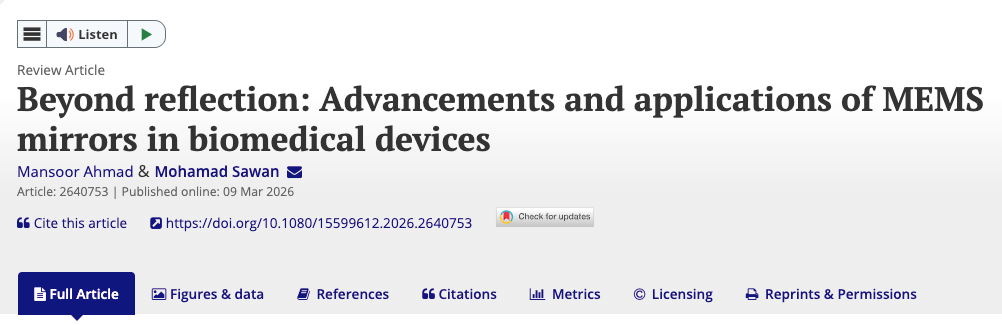
The review paper titled "Beyond reflection: Advancements and applications of MEMS mirrors in biomedical devices", co-authored by Dr. Mansoor Ahmad (first author), former Research Assistant Professor at CenBRAIN Neurotech Center of Excellence, and Chair Professor Mohamad Sawan (corresponding author), has been published in the International Journal of Optomechatronics.
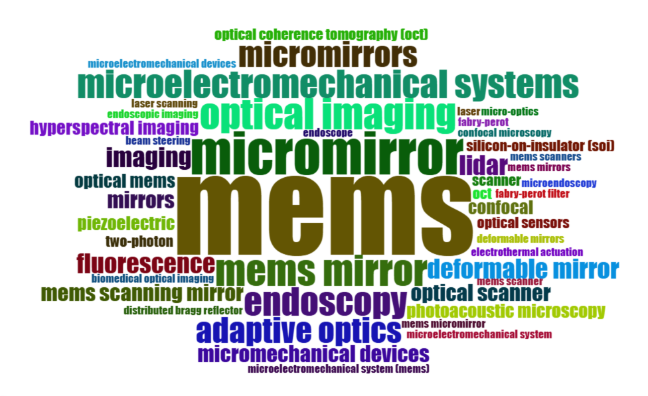
Figure 1. Word cloud summarizing major keywords and application areas related to MEMS micromirrors in biomedical devices.
Authors of this work systematically summarize the progress of MEMS micromirror designs, actuation mechanisms, and biomedical applications, while also identifying practical challenges related to scan angle, reliability, packaging, and clinical translation. The research was conducted at CenBRAIN Neurotech Center of Excellence, Westlake University is the primary affiliation.
Research Highlights
Reviews of recent advances in MEMS micromirrors for biomedical devices;
Summarizes of electrostatic, electromagnetic, piezoelectric, and electrothermal actuation mechanisms;
Highlights applications in OCT, endoscopy, confocal microscopy, photoacoustic imaging, and laser therapy;
Links micromirror performance parameters with biomedical system requirements;
Identifies challenges in reliability, packaging, actuation voltage, and clinical translation.
Abstract
This review concerns recent advancements and biomedical applications of MEMS micromirrors. It focuses on their performance, utility, and adaptability in optical imaging and therapeutic systems. We summarize major actuation mechanisms, including electrostatic, electromagnetic, piezoelectric, and electrothermal approaches, and relates these mechanisms to important device-level parameters such as scan range, response speed, power consumption, stability, and integration capability. Biomedical applications such as optical coherence tomography, endoscopy, confocal microscopy, photoacoustic imaging, adaptive optics, and laser-based treatment are highlighted. The review also includes a summary about current limitations, mirror deformation, actuation voltage, packaging complexity, reliability, and system-level integration. Overall, this review is useful for researchers working on MEMS micromirrors, optical scanning, biomedical imaging, and miniaturized medical devices.
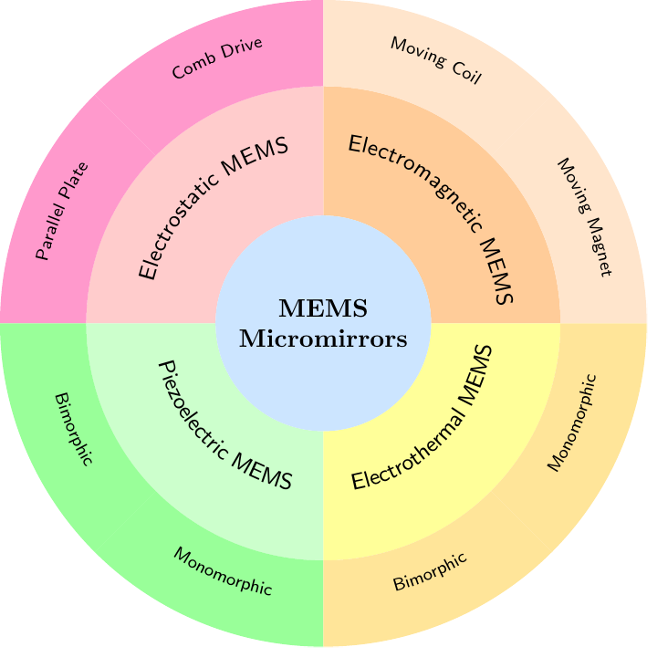
Figure 2. Main actuation mechanisms and subcategories of MEMS micromirrors.
Paper Information
Ahmad, M., & Sawan, M. (2026). Beyond reflection: Advancements and applications of MEMS mirrors in biomedical devices. International Journal of Optomechatronics, Vol. 20, Issue 1, 33 pages.
Click the link to access the full paper:
https://doi.org/10.1080/15599612.2026.2640753