Neural implants constitute core brain-computer interface (BCI) for decoding neural electrical signals and restoring sensorimotor functions in patients with neurological injuries. As the demand for high-density brain mapping escalates, the number of synchronous recording channels has expanded from hundreds to thousands, imposing a severe bottleneck on wireless data telemetry modules due to the massive throughput of acquired neural data.
Conventional narrowband communication protocols, including Bluetooth Low Energy (BLE), Zigbee, and the Medical Implant Communication Service (MICS)—suffer from limited data rates and suboptimal energy efficiency, rendering them inadequate for high-density neural acquisition. Impulse-Radio Ultra-Wideband (IR-UWB), characterized by its inherently broad bandwidth, high data throughput, and minimal tissue heating, has emerged as the preferred solution for next-generation implantable wireless communication. Nevertheless, existing IR-UWB transmitters confront two critical challenges: first, open-loop ring oscillators are highly susceptible to process, voltage, and temperature (PVT) variations, leading to substantial frequency drift, while conventional continuously operating phase-locked loops (PLLs) consume milliwatt-level power, thereby significantly curtailing implant battery life; second, the power amplifier (PA) and antenna necessitate on-chip matching networks, wherein passive components occupy far more silicon real estate than the active circuitry, severely constraining device miniaturization.
To address these dual constraints of power consumption and size, CenBRAIN Neurotech Center of Excellence led by Professor Mohamad Sawan published the latest paper in Sensors, proposing an innovative duty-cycled PLL and fractal antenna co-design architecture that simultaneously resolves the three major challenges of frequency stability, high power consumption, and chip area overhead.
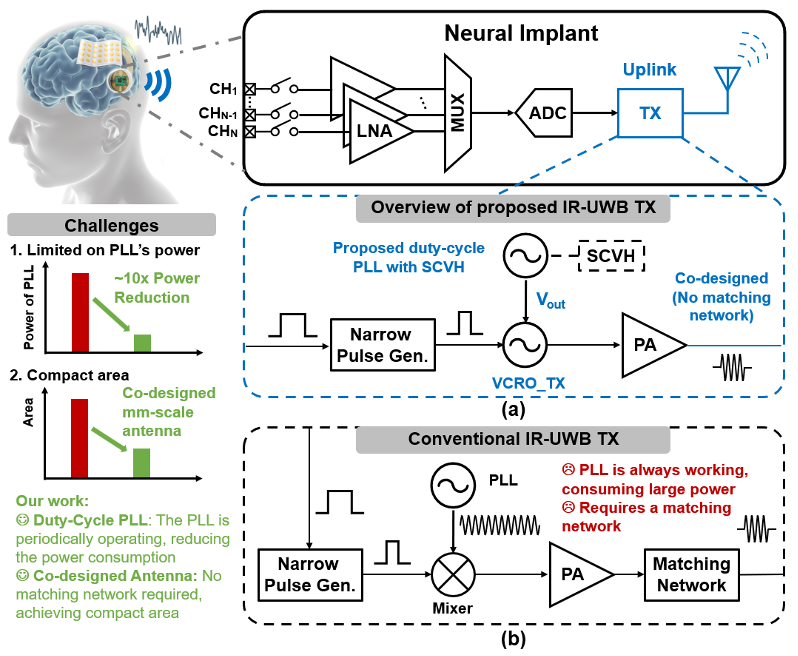
Fig.1. (a) Block diagram of neural implant integrated with the proposed IR-UWB transmitter, illustrating the new TX scheme with duty-cycled PLL (SCVH) and co-designed mm-scale antenna; (b) Conventional IR-UWB TX architecture with continuously operating PLL and mandatory output matching network.
The first author of this study is Dr. Wenjun Zou, a 2026 Ph.D. graduate from the Center, Professor Mohamad Sawan and Dr. Jie Yang serving as the co-corresponding authors.
Research Highlights
Intermittent-Calibration Low-Power PLL Architecture: A duty-cycled PLL featuring an SCVH voltage-holding module is proposed, with loop calibration active for only 10% of the period while the standby circuitry consumes near-zero power. At 4.25 GHz, the PLL consumes merely 90 μW — an 89% reduction over conventional continuous-operation PLLs — while achieving a phase noise of -91.66 dBc/Hz @ 10 MHz and a peak-to-peak jitter of only 2.14 ps, ensuring carrier frequency stability under extremely tight power budgets for implantable devices.
PA-Antenna Co-Design Eliminating On-Chip Matching Networks: Departing from conventional 50Ω antenna matching schemes, the customized fractal antenna's input impedance is conjugate-matched to the PA output (9.7−j20.7Ω at 4.25 GHz), eliminating the need for area-consuming on-chip inductors and capacitors. This significantly reduces both chip area and overall implant volume while lowering RF insertion loss.
Miniaturized Implantable Broadband Fractal Antenna: The 8 mm × 10 mm coplanar waveguide-fed fourth-order fractal structure, after silicone encapsulation and implantation into 18 mm muscle tissue, maintains a 3.97–4.57 GHz (600 MHz) -10 dB bandwidth with VSWR < 2 across the entire operating band, exhibiting omnidirectional radiation characteristics well-suited for lossy biological tissue transmission environments.
Full Tape-Out and Ex Vivo Tissue Validation: The complete system was fabricated in 40nm CMOS and validated through wireless communication tests in 18 mm porcine subcutaneous tissue. The transmitter supports OOK pulse transmission up to 200 Mbps, achieves a total power consumption of 0.58 mW, and delivers a comprehensive figure-of-merit (FoM) of 9.3 pJ/(b·V).
Abstract
This paper proposes a low-power impulse-radio ultra-wideband (IR-UWB) transmitter architecture with co-designed duty-cycled phase-locked loop (PLL) and compact fractal antenna for neural implant applications. A switch-controlled voltage-holding (SCVH) module is innovatively introduced to realize intermittent calibration of the PLL. Operating at a duty cycle of 10%, the proposed PLL achieves an ultra-low power consumption of 90 μW, which is reduced by 89% compared with the continuously operating PLL, and effectively suppresses the inherent carrier frequency drift of open-loop oscillators. A dual-oscillator topology is adopted in the design, in which one voltage-controlled ring oscillator (VCRO) is utilized for loop frequency locking, and the other dedicated VCRO provides carrier output for the transmitter.
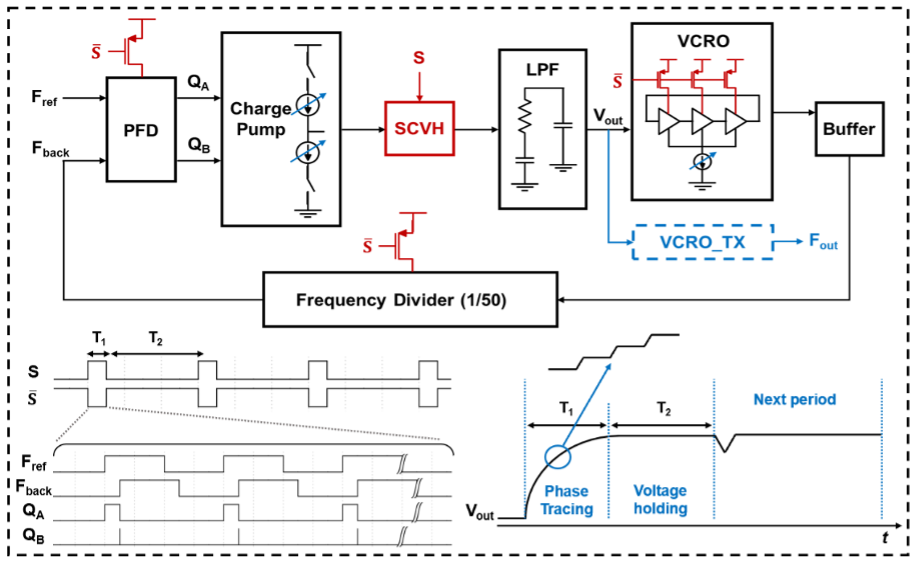
Fig.2. Architecture and timing diagram of the proposed dual-VCRO duty-cycled PLL, including waveforms of control signal S, reference/feedback clock, and control voltage Vout, demonstrating the time-multiplexed operating mechanism comprising calibration phase T1 and silent voltage-holding phase T2.
To eliminate the bulky on-chip output matching network and reduce the volume of passive matching devices, a compact fourth-order coplanar-waveguide-fed fractal antenna with a dimension of 8 mm × 10 mm is co-designed. The input impedance of the antenna realizes conjugate matching with the power amplifier output, which significantly miniaturizes the overall size of the implant system. The complete transmitter chip is fabricated using TSMC 40 nm 1.0 V CMOS process. In vitro wireless experiments through 18 mm thick porcine tissue verify the superior performance of the proposed design. The overall power consumption of the transmitter is only 0.58 mW, with a peak-to-peak output pulse amplitude of 310 mV and a −10 dB bandwidth of 1.02 GHz. The output spectrum fully complies with the FCC indoor radiation standard. Furthermore, the system achieves a stable energy efficiency of 2.9 pJ/bit at a data rate ranging from 10 Mbps to 200 Mbps, simultaneously realizing low power consumption, miniaturization, and reliable in-vivo wireless transmission performance for neural implants.
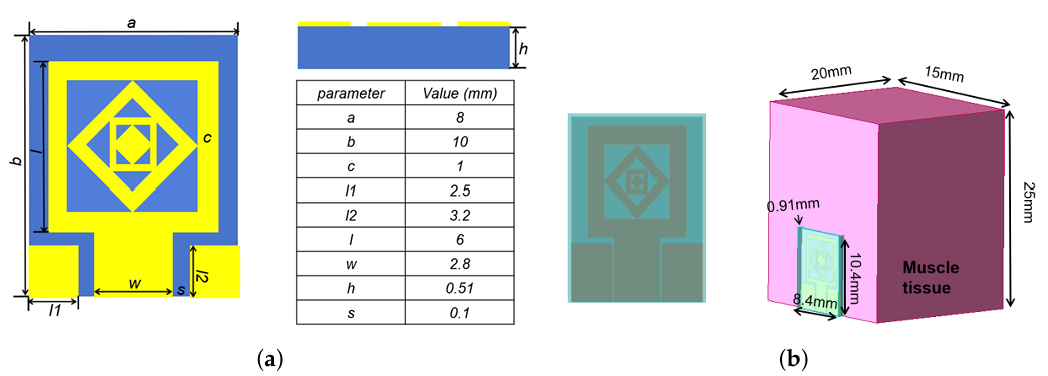
Fig. 3. Antenna structure and in vivo simulation model: (a) Geometry and dimensional parameters of the 8 mm × 10 mm 4th-order CPW-fed implantable fractal antenna; (b) HFSS simulation model of the silicone-encapsulated antenna implanted into 18 mm muscle tissue.
Paper Information
Zou, W.; Yang, J.; Sawan, M. A Duty-Cycled PLL and Fractal Antenna Co-Design Architecture for a Low-Power IR-UWB Transmitter in Neural Implants. Sensors, 2026, 26, 4241
More information can be found in this link:
https://www.mdpi.com/1424-8220/26/13/4241