Large language models (LLMs) are driving profound transformation across the healthcare sector. Far from being mere tools for text generation, they deliver tangible value throughout clinical decision‑making workflows, doctor‑patient communication, biomedical research and healthcare administration.
Even so, the real‑world clinical adoption of LLMs still faces considerable practical obstacles. Issues such as model hallucinations, algorithmic bias, patient‑data privacy risks, and inadequate interpretability for high‑risk medical scenarios continue to constrain their large‑scale rollout in routine care.
CenBRAIN Neurotech Center of Excellence published a review paper on the journal Wiley Interdisciplinary Reviews: Data Mining and Knowledge Discovery, which evaluates mainstream healthcare‑oriented LLMs, identifies key practical barriers via bibliometric analysis of 1841 papers, and proposes targeted solutions for clinicians and researchers.
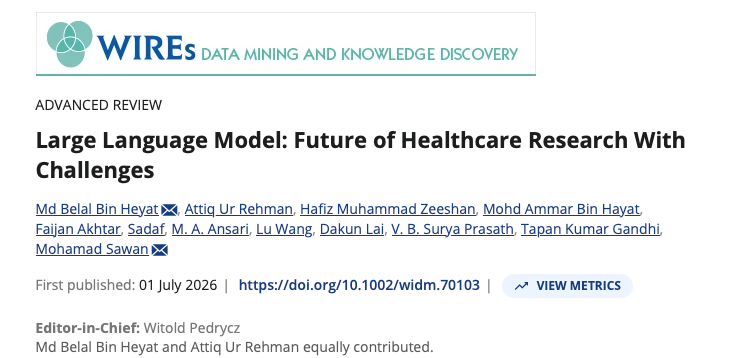
Dr. Md Belal Bin Heyat, a postdoctoral fellow as the co‑first author from CenBRAIN Neurotech, and Chair Professor Mohamad Sawan is the corresponding author. The authors would like to extend their gratitude to numerous collaborators from universities and research institutes worldwide for their support and contributions.
Abstract
Large Language Models (LLMs) carry transformative potential to reshape multiple facets of modern healthcare practice, from clinical decision‑support workflows and patient‑centered care to biomedical knowledge mining. This review assesses real‑world performance of representative LLMs including ChatGPT‑3, ChatGPT‑4 and BERT in optimizing disease diagnosis, therapeutic planning and the delivery of precision medicine. Based on bibliometric analysis of 1841 peer‑reviewed papers sourced from Web of Science, this paper characterizes publication dynamics, leading contributors and global geographic distribution within this fast‑growing research domain. A range of barriers persist for real‑world clinical deployment, such as algorithmic bias, limited model interpretability, patient‑data security vulnerabilities and mandatory requirements for domain‑specific fine‑tuning. This paper unpacks ethical and technical challenges associated with applying LLMs in clinical settings and proposes concrete recommendations for follow‑up investigations. Suggested directions include developing healthcare‑tailored LLMs, enhancing model transparency and explainability, improving data‑protection mechanisms, enabling continuous adaptive knowledge updating, facilitating deep integration with clinical workflows and building standardized regulatory and ethical governance systems. This review intends to equip medical practitioners, researchers and policymakers with integrated insights into LLMs’ transformative value and unresolved constraints, so as to advance responsible and safe adoption of large‑language‑model technologies across healthcare sectors.
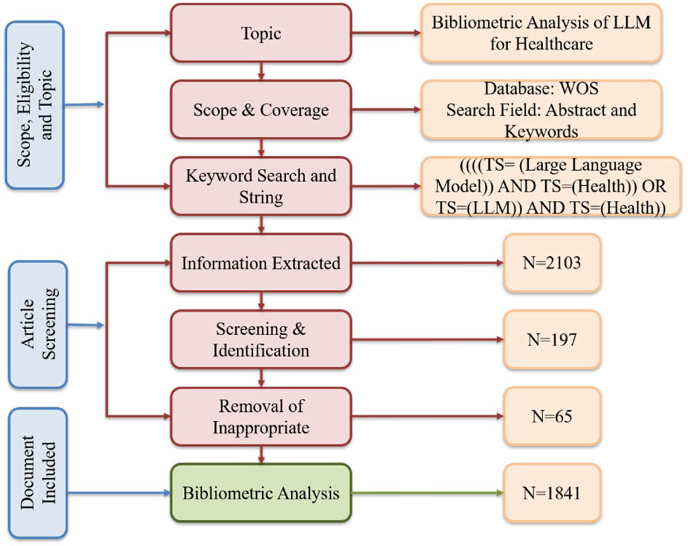
Figure 1: PRISMA‑based flow diagram illustrating the literature search, screening, eligibility, and inclusion process.
Reference
M. B. B. Heyat,* A. U. Rehman,* H. M. Zeeshan, et al. 2026. “Large Language Model: Future of Healthcare Research with Challenges.” Wiley Interdisciplinary Reviews: Data Mining and Knowledge Discovery, 16, no. 3: e70103. https://doi.org/10.1002/widm.70103.